

Published By Peter Davies
LOCKOUT/TAGOUT: A SIMPLE CONTROL THAT CAN SAVE LIVES
PMGS Health & Safety Blog
When machinery, electrical equipment or building services require maintenance, switching them off is not always enough.
Someone could unknowingly restore the power. Stored energy could be released. A machine could suddenly restart while another person is cleaning, inspecting or repairing it.
This is why a robust Lockout/Tagout procedure, often referred to in the UK as safe isolation or lock-off, is so important.
What is Lockout/Tagout?
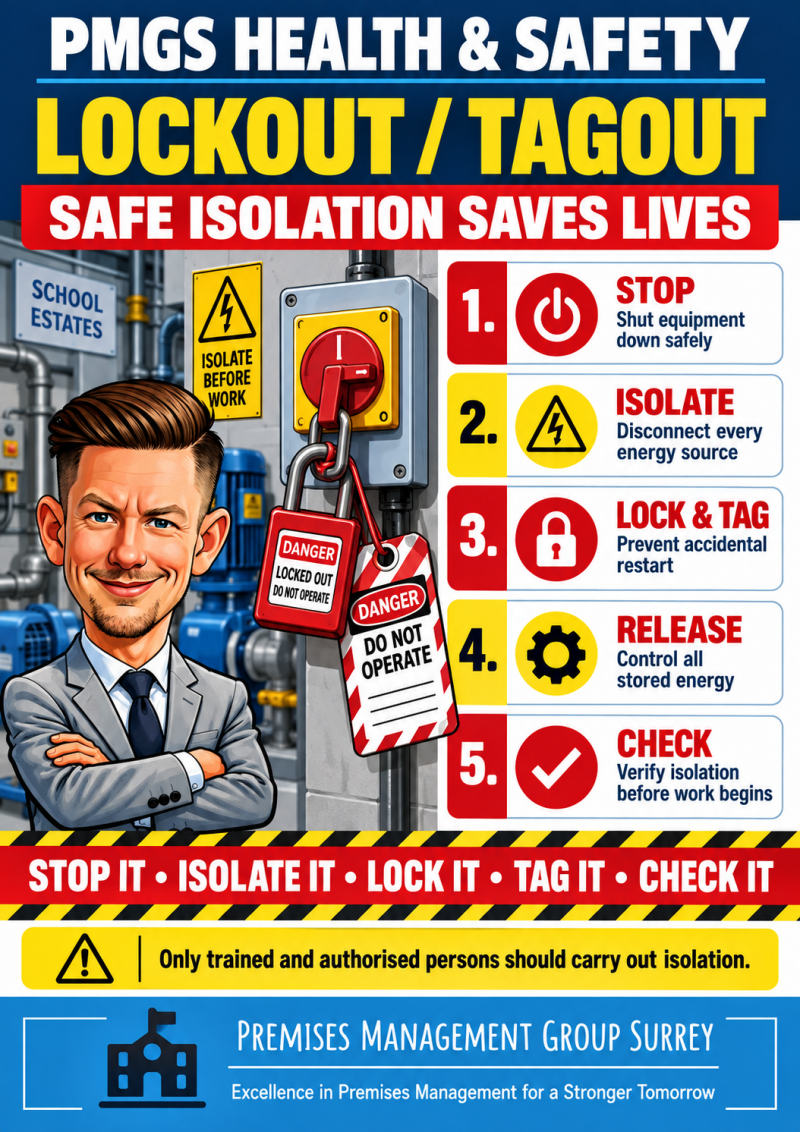
Lockout/Tagout is a controlled safety process used to isolate equipment from its energy sources and prevent it from being restarted until the work has been completed safely.
- Lockout: A physical lock is applied to an isolation point to prevent the equipment from being re-energised.
- Tagout: A clearly marked warning tag identifies that the equipment is isolated, explains why and names the authorised person responsible.
A warning tag communicates the danger, but it should not be treated as a replacement for physical isolation and locking where lock-off is reasonably practicable.
Energy is not limited to electricity
A suitable isolation assessment should consider every form of hazardous energy, including:
- Electrical power
- Gas
- Hydraulic pressure
- Compressed air
- Steam
- Pressurised water
- Mechanical movement
- Gravity
- Stored energy in springs, capacitors or batteries
- Heat and other thermal energy
Turning off a control switch does not necessarily remove all these hazards.
A typical safe-isolation process
The precise procedure must reflect the equipment, manufacturer’s instructions, risk assessment and organisation’s safe system of work. A typical process may include:
- Prepare and assess
Identify the equipment, hazards, energy sources and correct isolation points. - Notify affected people
Inform staff, contractors and others who may be affected that the equipment will be taken out of service. - Shut down safely
Stop the equipment using the approved shutdown procedure. - Isolate every energy source
Disconnect the equipment from electrical, mechanical, hydraulic, pneumatic or other energy supplies. - Apply locks and warning tags
The authorised person applies an individually controlled lock and a clear identification tag. - Release or restrain stored energy
Discharge pressure, secure raised components, allow hot surfaces to cool and control anything that could move unexpectedly. - Verify the isolation
Confirm that the equipment is safely isolated using the approved testing method before work begins. - Complete the work
Maintenance should only be undertaken by competent and authorised people. - Inspect and safely restore service
Check that guards have been replaced, tools removed and people are clear before locks are removed and energy is restored.
The “one person, one lock, one key” principle
Where personal locking systems are used, each authorised worker should control their own lock and key.
Nobody should remove another person’s lock without following an approved, documented and properly authorised exceptional-removal procedure. A lock must never be cut off merely because restoring the equipment would be convenient.
For work involving several people or contractors, a formal group-isolation or permit-to-work arrangement may be required.
Why this matters within schools and estates
School and facilities environments contain more hazardous equipment than many people realise, including:
- Boilers and heating plant
- Pumps and motors
- Kitchen equipment
- Mechanical ventilation systems
- Powered gates and shutters
- Cleaning machinery
- Workshop equipment
- Lifts and lifting equipment
- Water systems and pressurised pipework
- Electrical distribution equipment
Maintenance may also take place while staff, pupils, hirers or contractors remain elsewhere on the site. Clear communication, barriers, access control and contractor coordination are therefore essential.
The Health and Safety Executive advises that plant and equipment must be made safe before maintenance begins. Energy supplies should be isolated, machinery locked off where accidental reconnection is possible and stored energy safely released. Maintenance must also be properly planned and undertaken by competent people. HSE guidance on maintaining work equipment
HSE guidance also confirms that electrical equipment must be maintained to prevent danger, with checks, inspections and testing based on the equipment, its environment and previous results. HSE guidance on electrical-equipment safety
Common mistakes to avoid
- Assuming that pressing “stop” makes equipment safe
- Isolating only the electrical supply while overlooking other energy sources
- Using a warning tag without an effective physical isolation
- Failing to verify that the equipment is de-energised
- Allowing unauthorised people to remove locks
- Using shared or unidentified keys without proper control
- Starting work without informing affected staff
- Allowing untrained staff to undertake specialist maintenance
- Restoring power before guards and safety devices have been replaced
- Failing to record, review or audit the procedure
The PMGS message
If equipment is being repaired, cleaned, inspected or maintained, it must not be capable of unexpectedly starting or releasing hazardous energy.
Lockout/Tagout is more than a lock and a warning label. It is a disciplined process involving planning, communication, isolation, verification, competence and controlled restoration.
A strong safety culture does not rely on assumptions.
Stop it. Isolate it. Lock it. Tag it. Check it.
Premises Management Group Surrey
Excellence in Premises Management for a Stronger Tomorrow
🌐 www.schoolpremisesmanagementcleaningsolutionsservices.co.uk
📧 info@premisesmanagementgroupsurrey.co.uk
☎️ Office: 020 3952 1438
📱 Mobile: 07523 024900
💬 WhatsApp Business: 07517 819936
This blog provides general awareness information. Lockout/Tagout and safe-isolation procedures must be developed from a suitable risk assessment, manufacturers’ instructions and competent professional advice.
Add comment
Comments