

Published By Peter Davies
What Happens Between a Fault Starting and Someone Reporting It?
A PMGS Blog | Premises Management Group Surrey
A dripping tap.
A door that starts catching.
A light that flickers occasionally.
A small patch of damp on the ceiling.
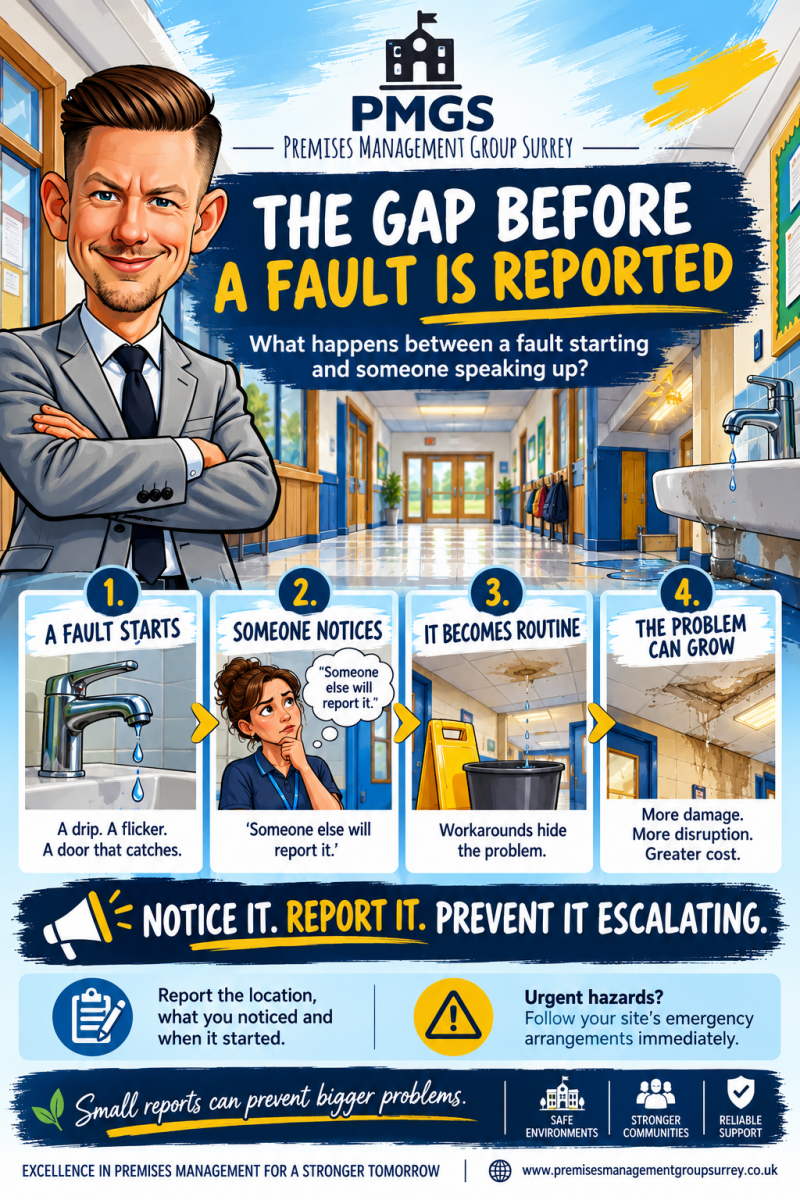
Before a fault reaches the premises team, it may already have been noticed several times.
That gap between a fault starting and someone reporting it is easy to overlook.
Yet it can give a manageable problem time to worsen, disrupt the building or become more expensive to repair.
The fault begins
Some faults appear suddenly.
Others develop gradually, with signs that are easy to miss during a busy day.
A loose fitting may still work.
A slow leak may leave only a faint mark.
A door may close properly most of the time.
The building continues operating, but something has changed.
Someone notices—but hesitates
Seeing a fault does not always lead to reporting it. Someone might think:
- “Someone else must have reported it.”
- “It’s only a small problem.”
- “The premises team are already busy.”
- “I don’t know who to tell.”
- “I’ll mention it later.”
These are understandable reactions.
They also show why reporting needs to be simple, familiar and encouraged.
The problem becomes part of the routine
People can start working around a fault: avoiding a troublesome door, using another tap or putting a container beneath a drip.
As the workaround becomes familiar, the fault attracts less attention.
A new member of staff may even assume that this is how the building normally operates.
An unresolved problem has become an accepted part of the working day.
Meanwhile, the fault may worsen
A small leak can spread into surrounding materials. A loose component can deteriorate further.
An intermittent equipment fault can eventually cause a breakdown.
Not every fault will escalate, but leaving it unreported prevents the premises team from assessing its condition and deciding what action is needed.
A report starts the response
A useful report gives the team enough information to find and assess the problem:
- The exact location.
- What has changed or stopped working.
- When it was first noticed.
- Whether it happens continuously or occasionally.
- Any immediate effect on people or access.
- A photograph, where safe and appropriate.
Staff do not need to diagnose the cause.
Describing what they have observed is enough to get the process started.
Urgent hazards should be raised immediately through the site’s emergency arrangements, rather than left in a routine maintenance queue.
Closing the gap
At PMGS, we believe good premises management starts with people feeling confident to speak up.
Clear reporting routes, regular inspections and visible follow-up all help.
When staff receive an acknowledgement and understand what happens next, they have more reason to keep reporting concerns.
A report should also be recorded and tracked so that it remains visible until it has been assessed and resolved.
The aim is to make noticing and reporting a normal part of caring for the building.
The PMGS message
A fault does not begin when it appears on the jobs list.
It begins when something changes—and the time before that change is reported matters.
Notice it. Report it. Help prevent a small fault becoming a bigger problem.
Peter Davies
Founder & CEO
Premises Management Group Surrey — PMGS
EXCELLENCE IN PREMISES MANAGEMENT FOR A STRONGER TOMORROW.
Add comment
Comments